Wednesday, April 17, 2013

MUSEE DE CLUNY -- MIDDLE AGES


On the left bank near the Sorbonne is a marvelous gem of a museum of the Middle Ages, the Musee de Cluny.  The museum is founded on two ancient sites: Roman baths of Lutetia, as Paris was called in the time of the Roman Empire; and, a Clunaic monastery from the early 15th century, a replacement of their 13th century building used to house monks of the order.  The building has been modernized over the intervening centuries and now houses artifacts from the period after the fall of the Roman Empire to the beginnings of the Renaissance in the 15th century.
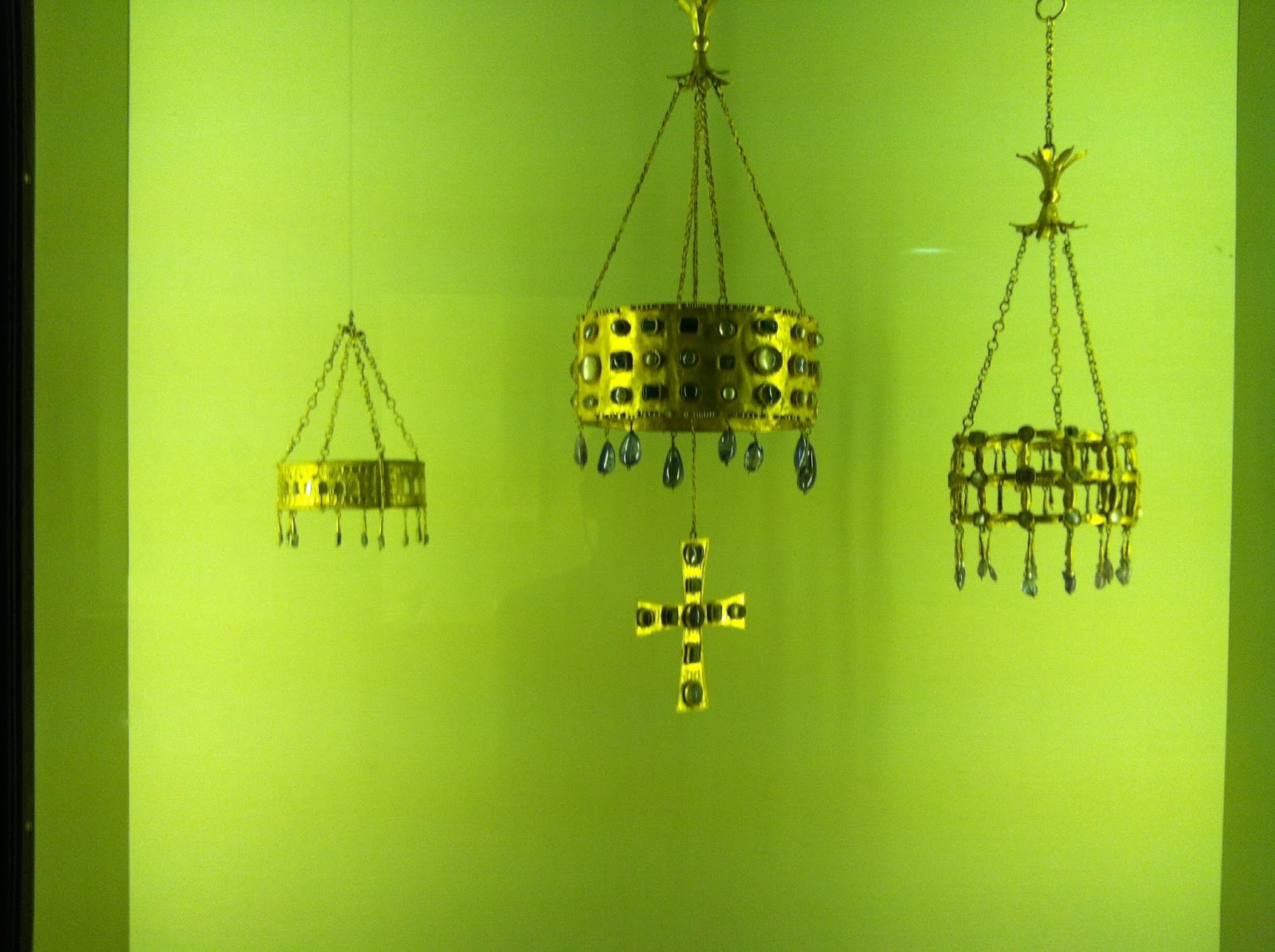
Visigoth crown

Carved choir stall

Tapestry of the hunt

Kings of Judah

And what is seen here in the cool darkened rooms of this former monastery? 

A 7th century gold votive Visigothic crown, set with sapphires and emeralds, uncovered in Spain.

A wooden choir stall from XV century Beauvais extended along the walls of a long narrow room. Beneath one wooden seat was an elaborate carving of a truncated man with puffed cheeks blowing on a stalled windmill, hoping to turn the blade. Clearly, its anonymous artisan in the Middle Ages knew that wind was an unreliable source of power. 

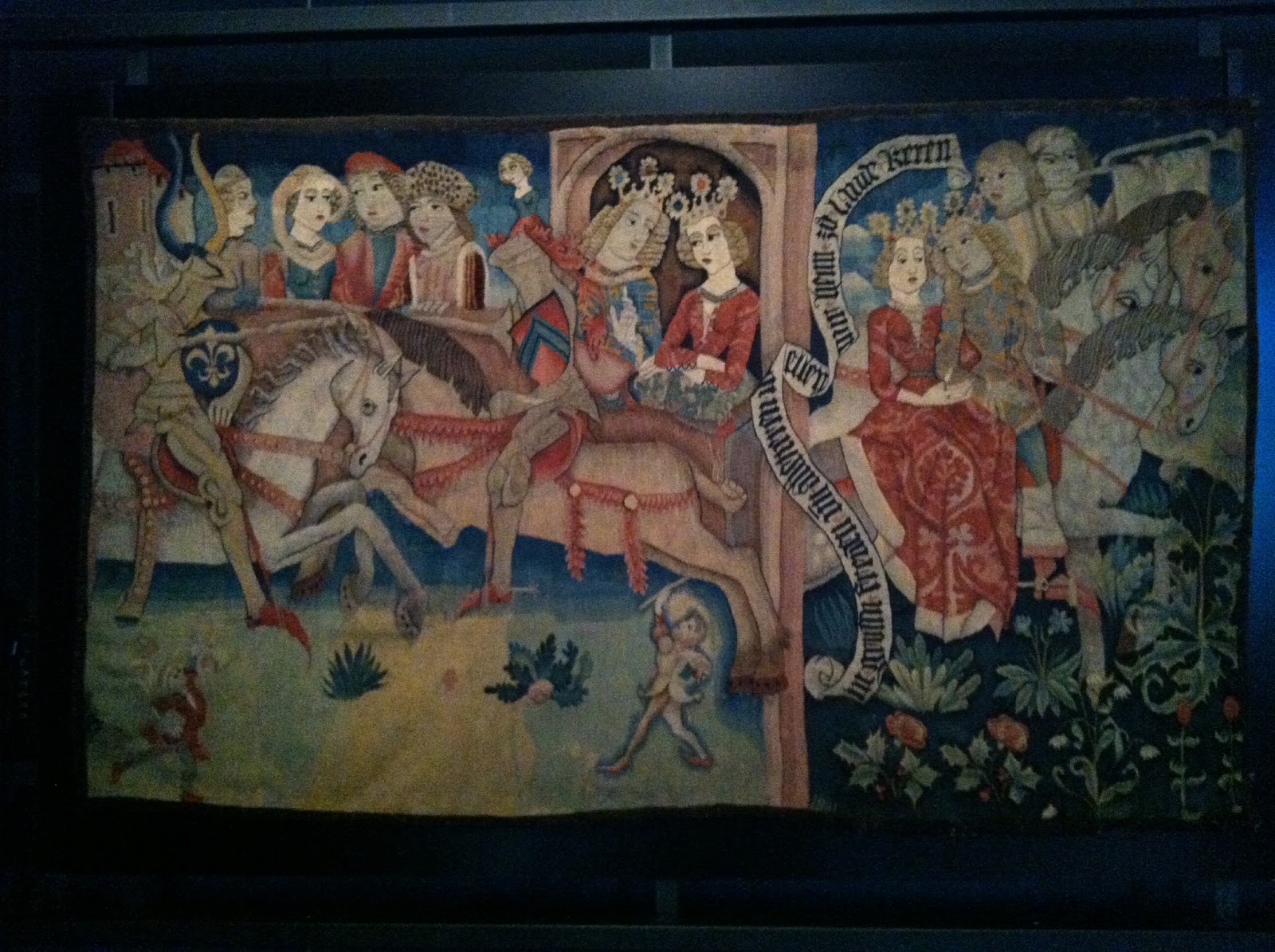
Walls covered with tapestries depicting scenes of the hunt and tapestries of tournaments – sports used to prepare knights for real battle. Assorted shields, body armor, helmets and swords used by knights and foot soldiers.  Several hand written copies of the Book of Hours which had been used by monks at prayer and early sheet music used in churches for Gregorian chants. 

Heads of the Kings of Judah uncovered recently during road construction in Paris. The heads from the medieval sculptures were removed from full sized figures during the Reformation.
 
 These ancient objects were a feast for the imagination. 


MONET -- GIVERNY & MUSEE DE L'ORANGERIE


 Claude Monet bought a farmhouse and accompanying piece of property about 45 miles outside of Paris in the town of Giverny. Intrigued by Japanese art and landscape paintings, Monet excavated a pond fed by water from the Seine River which passed nearby and built a small simple bridge with a handrail over a narrow outlet of the pond.  He surrounded the pond with attractive gardens and willow trees, planted bamboo from the Orient and brought in water lilies to bloom on the watery surface.  Thus he created an outdoor setting to complement his extensive collection of Japanese prints that he hung in his nearby home.  

Although Claude Monet had painted versions of his bridge and the water lilies in regular sized paintings, in his later life, he painted a water lily series specifically for the Musee de l’Orangerie. In fact, the museum’s space was specifically constructed for these unique works of art. These canvases, with the images of the Giverny water lilies in various seasons and times of day, cover the walls in two very large, elliptical rooms. With no sense of depth, the aquatic plants float vertically on the watery canvas almost independent of the canvas itself.  It is said that the clouded abstract nature of the water lilies may have had something to do with the way Monet was actually seeing his treasured plants; at the time, he was suffering with cataracts and so took advantage of his personal imaging to present us with this masterpiece.  So, was it an abstract vision?  Or his true vision?  Or maybe he took advantage of his true vision to give us an abstract vision. 

Monday, April 15, 2013

MARCEL BREUER AT THE FRENCH MUSEUM OF ARCHITECTURE

Designed in 1937 in a dull neoclassical style for the Paris Exhibition, the Chaillot Palace has been converted into a museum of architecture, with a elaborate French name, La Cite de L’Architecture and du Patrimonie.  One of its best features is that it overlooks the Eiffel Tower with one of the best views of this impressive 19th century structure, a signature of the Paris skyline. Currently, the museum has a special exhibit of the life and works of Marcel Breuer.

Marcel Breuer (1902-1981), a Hungarian of Jewish descent, was one of the founders of modern architecture. Breuer joined the Bauhaus School in the mid-1920’s, first as a student and later as a teacher.  Here, he designed his famous tubular steel chair, inspired by the curved handlebars of his bicycle.  This chair, with its cantilevered leather strapped back, seat and arms, has remained a classic piece.

After fleeing Nazi Germany in the early 1930’s, Breuer first went to London and then to Boston where he taught at Harvard Architecture school with Walter Gropius.  He and Gropius parted ways in 1941 when Breuer moved to New York to establish his own architectural firm.  He is credited with the design of multiple private homes, the Ameritrust building in Cleveland, the Whitney Museum in New York and the UNESCO Headquarters in Paris.   

He first focused on “people sized” objects—chairs, tables, desks -- and then expanded to single family houses and finally large public buildings. Marcel Breuer placed his own career in perspective when he commented that architects of monumental projects must begin with smaller objects that people can use.  He felt this was a necessary step to grand design since ultimately, all buildings are used by people --- not giants.


Model for home in Lincoln, MA

MUSEE NATIONALE DE LA LEGION D'HONNEUR


After visiting the Musee d’Orsay with its amazing collection of Impressionist art (I was impressed), we stopped across the street. Here, in an 18th century mansion, is housed the Museum of the Legion of Honor, which displays a fascinating collection of military medals.  Napoleon, the 19th century leader of France, general, dictator and later emperor – the model for future autocrats -- believed in giving his soldiers medals.  Even more, he gave himself bejeweled medals, several of which were shown in a display case under his portrait as Emperor.  You can see many medallions on a long gold chain draped around his neck, reflecting the highest order of the The Legion of Honor. To impress his subjects and to glorify himself, he is attired in a long white ermine robe.  Some ego!
Napoleon's Legion d'Honneur

Napoleon as Emperor
Modest Medals!!

Israel Defense Force Medals

Memorial to Captain Charles Austin


On view also was the Purple Heart, a badge for extraordinary valor in battle, first granted by George Washington to soldiers in the Revolutionary War. At that time, it was known as The Badge of Military Merit; later it was given solely to soldiers wounded or killed in the line of duty.  Its simple design conveyed a much more modest statement of loyalty and sacrifice, befitting those fighting to preserve a democratic republic.

In the long paneled medal room, drawers slid open to reveal honors granted by other nations to their soldiers. The State of Israel used plain colored ribbons hung with unadorned burnished bronze symbols of the service branch (Army, Navy, Air Force) to honor their soldiers.  David Ben Gurion, Israel’s first President, felt it important to keep commemorations simple and egalitarian, since everyone in that small nation makes significant sacrifices in military service for a good part of their adult lives.

The final commemoration came the next day in a small rural town, Limetz-Villez, en route to Paris from Giverny. Here a sculpture - - made from a single bent propeller blade from his crashed P-47 Thunderbolt - - honors an American hero, Captain Charles A. Austin. He was part of the great American army that had come to fight to preserve freedom in Europe. On July 4, 1944, Captain Austin’s plane was hit by German anti-aircraft flak. To avoid crashing into an inhabited French town and killing its innocent citizens, the pilot downed his plane in the outskirts of the village.  In war, all give some and Captain Austin gave all.

Saturday, April 13, 2013

CRYPT OF NOTRE DAME DE PARIS

-->
-->
About 200 yards in front of the main entrance to the Gothic Notre Dame cathedral, one enters the Crypt Museum where, underground, one can view some of the archeological history of Paris from pre-Roman times to the late 19th century. These excavations on the Ile de la Cite, the oldest part of Paris, were carried out from 1965-1972.  The crypt space was open to the public in 1980 and its display modernized after 2000. 

Underground one sees the remains of a quay and its steps to the river where boats tied up to carry on trade in the 1st century.  At this time, this Gallo-Roman town was known as Lutetia. 
Extensive remains outline its defensive walls and ramparts and confirm it as a strategic center for the Roman Empire, as it defended itself against the barbarian tribes coming across the Rhine. Stone structures define the Roman bath system --  the benches, the tepidarium, where one oiled the body and scraped away impurities with a strigil, the caldarium, the heating system, and changing rooms  -- where Roman citizens came daily for cleanliness, conversation and pleasure. 

Along with these more ancient archeological findings are also layers from cellars of homes from the middle ages. 

Steps to Gallo-Roman quay

Medieval cellar

Diagram of Roman baths

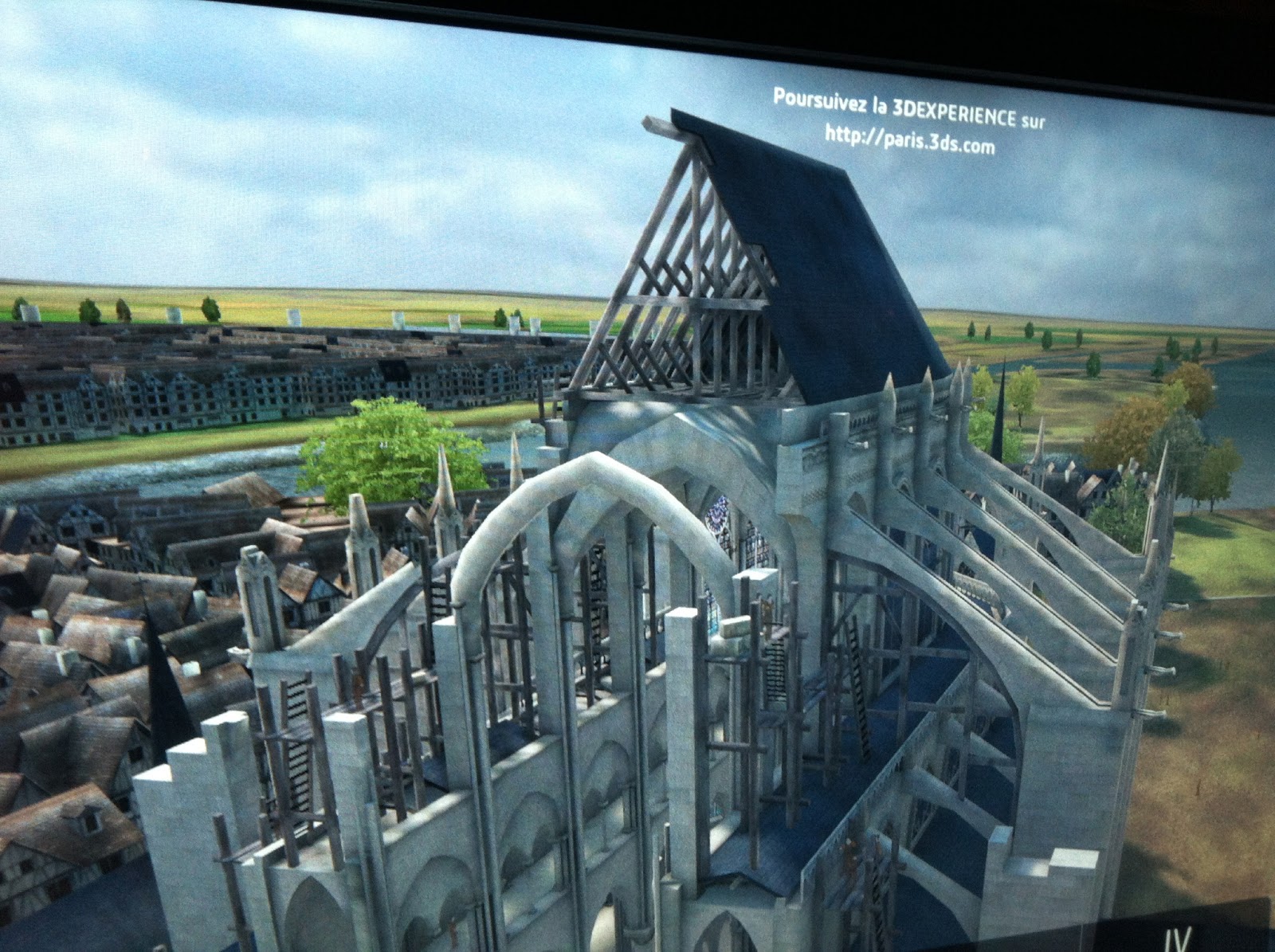
CAD of 13th century view of Notre Dame

Facade of Notre Dame, 2013

Add caption
But even as all the old stones tell stories of the past, possibly the most amazing part of the visit was the 3D Dassault computer display of the construction of Notre Dame cathedral over the course of 200 years, beginning in 1163.  One could zoom in and out and rotate the image on any plane for a view from the ground to a view from the air above for any of the four time periods depicted. Computer Aided Design -- amazing to us, but how would it seem to those who built the cathedral!         

Wednesday, March 6, 2013

TITAN MISSILE BASE, SAHUARITA, AZ


In 1957, the Soviet Union launched Sputnick. To this demonstration of rocket capacity, the United States responded with a vigorous and focused effort to develop both space and ICBM programs.  By 1963, after a 3 year development program, the US began to deploy the first of its 54 Titan II Missiles as part of the Mutual Assured Destruction strategy (MAD) and the world lived with a balance of deterrence. This theory postulated that the Soviet Union would not use a nuclear weapon since it recognized that the United States would retaliate with its own nuclear arsenal that would obliterate the Soviet Union itself.  The plan clearly depended on the rationality of the two main adversaries.

From 1966 to about 1985, our 54 Titan missiles, each with a single 9 megaton hydrogen warhead, guaranteed our security.  Eighteen were located over an extensive region in the desert area south of Tucson.  It took only 58 seconds to launch the missile after the command was given to the four man crew at each missile silo.  The missile would take about 30 minutes to travel its full 6,300 mile range to one of the three sites that had been pre-targeted for each particular missile.  The crew did not know the destination of the single missile for which they were responsible, except by numbers 1, 2 or 3.   

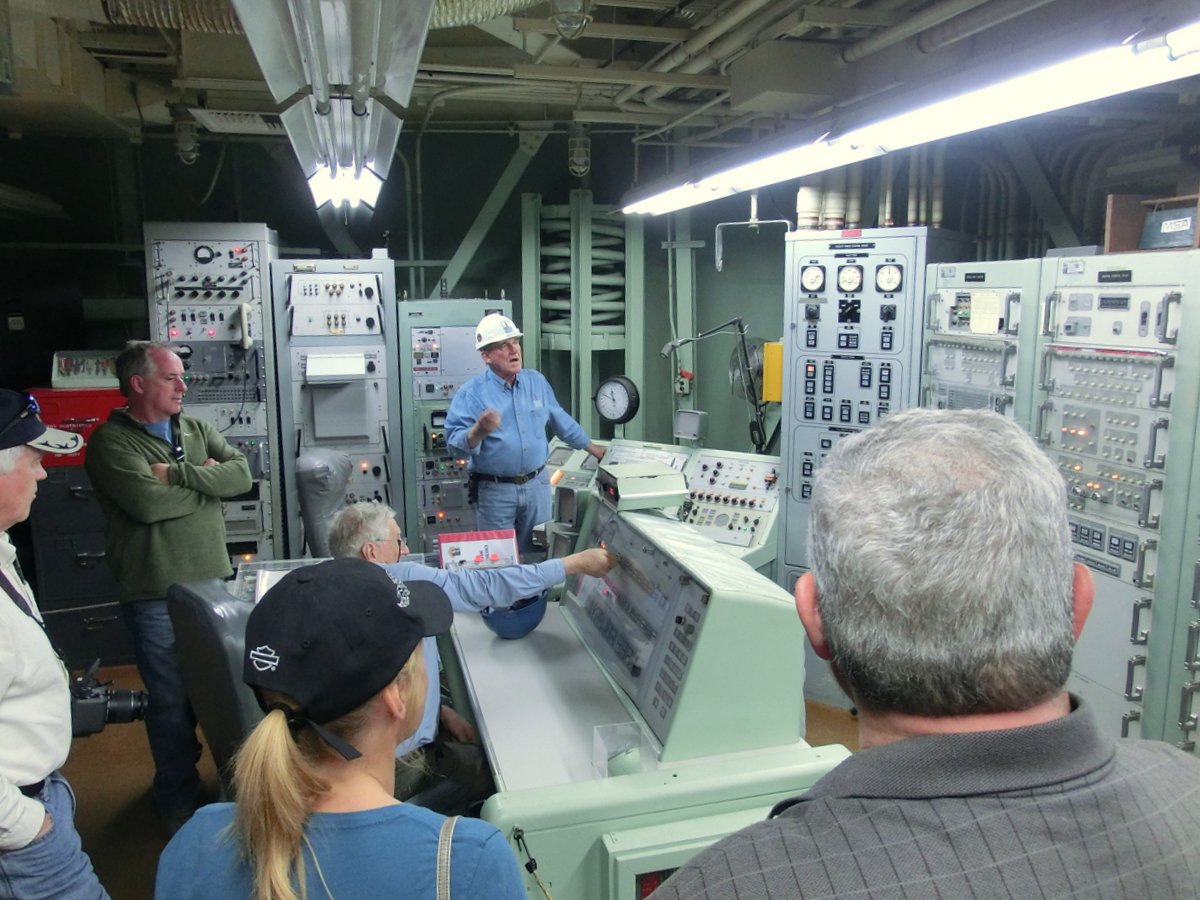
Control Room

Shock Absorbers to insulate the entire missile silo from an enemy atomic blast

OOPS! Bob turns key to fire the missile.

Titan missile in its silo, ready to be launched
In the mid-1980’s the liquid fueled Titan II missile was replaced by the solid fueled Minuteman Missile then stationed in the north central parts of the US.  After it was decommissioned as a weapon, the Titan missile had many iterations that were used in space launches for both military and non-military purposes. No launch ever failed. The Titan was retired after its last ignition in 2005 at Vandenberg Air Force Base in California. The Titan missile, originally developed as the ultimate military deterrent, achieved its greatest successes as the launching platform for at least 10 manned space flights of the Gemini program, multiple interplanetary probes, many weather and communications satellites.  In retrospect, with all its successes, it may be best known as the great peace keeper during the Cold War era. 

For more information about this particular missile site:
http://en.wikipedia.org/wiki/Titan_Missile_Museum


And for more information about the Titan missile in general:
http://en.wikipedia.org/wiki/Titan_%28rocket_family%29

Photos courtesy of our friend, Kirk DeNee


Sunday, March 3, 2013

KARTCHNER CAVERNS STATE PARK, AZ


In 1974, about 40 miles south of Tucson near the town of Benson, two teen age boys explored a sink hole formed by a surface collapse over limestone rock. They crawled through a small opening, the size of a rounded wire coat hanger, into a passageway that led to a large underground room--- the first of at least two large rooms that they were to discover and explore over the next several years.  They were committed to keeping the existence and whereabouts of the cave an absolute secret so that it would not be “trashed” by unwanted visitors in such a way as to “kill it.”  Caves are living ecosystems. When exposed to the air and visited by unmonitored people who could scratch their names in the rocks, break off samples, or remove specimens, they die and become inert holes in the earth.  Ultimately, the two young men had to enlarge the circle of people who knew of the cave from the landowners (the Kartchners) to state officials whose approval and legislative know-how would be necessary to preserve the caves in the Arizona State Park system.  25 years after the discovery of this treasure, the Kartchner caves were opened with a triple air lock entry system, washable concrete walkways separated from the cave surface and limited lighting to promote the preservation of the cave’s ecosystem. Because of all these efforts, these caves are truly preserved.  The Kartchner Caves are unique in the country--- and possibly the world.

For more information about the discovery of the Kartchner Caves, click

As you can understand, no personal photography was allowed in the caves.
For official photos, click      http://azstateparks.com/Parks/KACA/gallery.html