Friday, November 16, 2018

THE OLD CITY, JERUSALEM

THE OLD CITY 

Inside the Old City in Jerusalem are the holy sites that are most sacred for Jews, Christians and Moslems. After the Six Day War in 1967, Jerusalem was re-united as part of Israel.  As IDF Col. (Ret.) Miri Eisen, former spokesperson for the Prime Minister, told us - Israel sees it as a great honor to be entrusted as the custodian of these age-old religious sites in Jerusalem. And Israel feels it has a special responsibility to protect these sacred sites and to keep them open for those who wish to visit. Since Jerusalem has been reunited under Israeli control, each sacred site has been placed under the direction, law and protection of leaders from its own faith - Jewish, Christian or Muslim. 

Before 1967, access to the Jewish sites was forbidden by the Jordanians who held the older half of Jerusalem after the 1948 War. In fact, the Jordanians made a concerted effort to wipe out the any trace of the 3,000-year Jewish presence in the Old City. The Jordanians destroyed the Jewish Quarter including its grand synagogue, built a road through the ancient Jewish cemetery on Mt. Scopus paving it with memorial headstones and forbade access to the Western Wall of the Temple Mount. Although the reconstruction had been planned, on his 2009 visit to Israel, Bob saw only one remaining arch of the domed Great Synagogue surrounded by rocky rubble where the Synagogue had once stood; on this visit in 2018, we saw the Synagogue totally rebuilt and now serving its original function—as a place of worship and study. The new interior and exterior were copied from photos taken in the 19thand 20thcentury.  A yeshiva/school is connected to it as in the past. And fulfilling the ancient prophetic vision of Zechariah 8:5, “and the streets of the city will be filled with boys and girls playing there,” the stone plaza outside was filled with young boys in white shirts and black pants kicking a soccer ball.

In large numbers, alone or walking with guides speaking many different languages, Christians and many others visit the Church of the Holy Sepulcher within the Old City. Tourists waited in long lines  to kneel at the holiest site within the church, where Christians believe Jesus was placed when he was brought down from the Cross.

Access to the sacred Muslim Dome of the Rock is open but carefully monitored to assure peaceful access.  Jewish guided groups are limited to specific times and a specific narrative—no talk of the First or Second Temple. 

Israeli archaeologists have conducted meticulous excavations to reveal the sites and the stories of ancient times. This research has to be done with sensitivity and concern so as not to disturb any possible future excavations. Archeologists also consider the interests and views of all religious groups.  

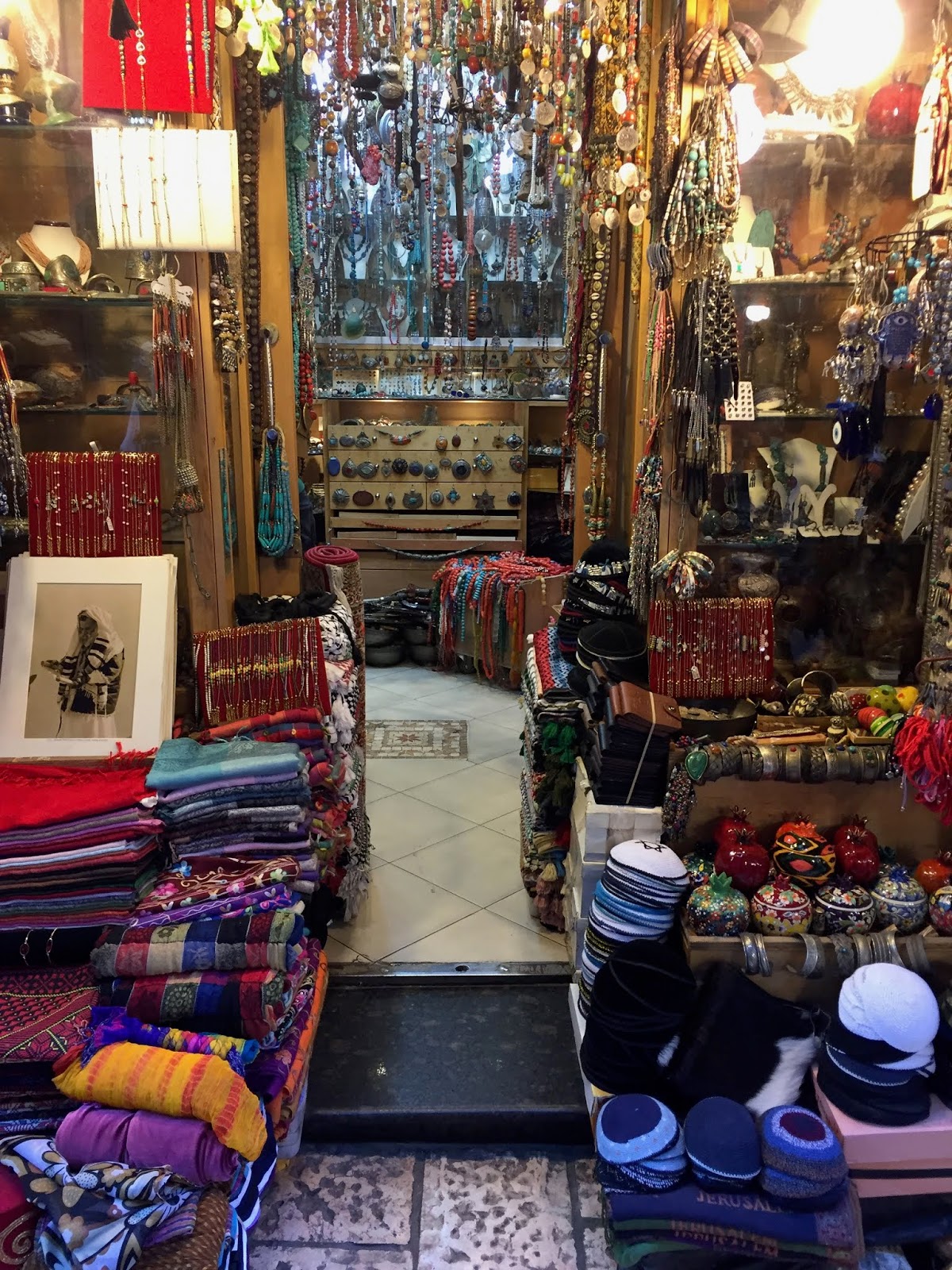
The Old City is very vibrant. One walks up and down stone staircases to get from place to place. In the middle of the steps is a stone ramp, used by merchants to wheel a cart through the slope to restock their shops. Merchants in the Arab market or souq, located in the Christian and Muslim quarter of the Old City, sell spices, shawls, leather goods, all types of merchandise from their stalls in this labyrinth of alleyways.

Look around within the Old City and one sees the mosaic of cultures that form today’s Jerusalem ––Arabs in hijabs, orthodox men in black coats, young people in shorts and tee shirts with slogans, IDF soldiers in uniform - every matter of dress.  There undoubtedly are hidden cameras but few or no guns are seen. Add to this, tourists from every continent and you have an amazing mix of people. We are grateful to see peace in Jerusalem as people stroll past each other talking, browsing, and enthralled by the mystique of the Old City.


Snapshot taken by a Peruvian tourist we met

A stall in the souq - marketplace

Remnants of destroyed synagogue

Mosaic from Church of the Holy Sepulchre

Praying at the Western Wall

View of the Old City - the Dome of the Rock

The rebuilt Grand Synagogue with a Menorah in front

Courtyard of the Church of the Holy Sepulchre

Tuesday, November 13, 2018

MACHAL MONUMENT TO FOREIGN VOLUNTEERS

MACHAL MONUMENT TO FOREIGN FIGHTERS

In May, 1948 after Israel declared its independence, it immediately had to deal with an invasion from all the surrounding Arab states: Lebanon, Syria, Egypt, Saudi Arabia, Jordan plus others along the N. African coastline.  Although the Jewish population of the Mandate had fought with the British during WW II, the British gave their weaponry and strategic positions to the Egyptians and Jordanians. The Israelis, although able soldiers, had no officer corps to strategically organize the army or to plan for battle. They had no air force, no tank corps, no navy…the situation appeared dire.

To their rescue came foreign fighters -- officers and men -- many of whom had already demonstrated their capacities as they helped transport surviving European Jews escape from displaced persons camps to what was then Palestine. 3500 volunteers came from over 46 countries; 120 heroically died.  Among the 120 were eight non-Jews and 4 women. These volunteers made a truly significant contribution to the Haganah, soon to be renamed the Israel Defense Forces (IDF). The officers lent organization and leadership to the nascent army.

Colonel Mickey Marcus, a graduate of West Point, a WWII Pentagon planner and paratrooper who jumped into Normandy, not only wrote the first organizational-training manuals for the IDF, but also played a critical role in the liberation of Jerusalem.  The large Jewish community in East and West Jerusalem were under siege by the Jordanian army.  The Old City with its ancient Jewish Quarter fell after bitter fighting, but the newer part of the City held on tenuously as the war continued.  Supply of this besieged population was a major problem. Multiple attempts to break the siege failed as the only road to Jerusalem from the Mediterranean coast was an easy target as it took a winding path through steep sided ravines controlled by the Jordanians. To this day, as monuments to that effort, burned out trucks and armored vehicles remain on the side of the road. Mickey Marcus saw the futility of the attempt to break the blockade using this road and developed a plan to build an alternate route to bypass the Jordanians and reach the heights of Jerusalem. 
Machal Monument with the names of those foreign fighters who perished

Lee Glassman at the Machal Monument

Hebrew Letters forming a Memorial Candle
He called it the “Burma Road” recalling the successful American effort to build a new road as an alternate supply route to the Chinese in Southeast Asia during WWII.

After the new road to Jerusalem opened, the Jewish fighters were able to end the siege just before they would have had to surrender to the Jordanians. The Israelis now, by their very presence, could truly claim Jerusalem as their capital. Nonetheless, it was not until June 1967 that all of Jerusalem was united during the Six Day War. Mickey Marcus was a true hero in the struggle for Independence.  Sadly, shortly before the armistice, as he walked at night across the barbed wire line to re-enter his base, he was shot by one of his own Haganah soldiers. He did not understand Hebrew and failed to respond to the call for the password. 

Jewish foreign pilots from abroad staffed thenascent Israeli air force. At the very beginning, six piper cub aircraft were acquired as the first planes in the Israeli air force . Machalvolunteers recruited other fliers from all over the world to buy and then fly their planes to Israel...during the conflict. One of these heroes was Al Schwimmer who recruited fliers in the US to take transport planes to Israel. Among his first purchases was a C-46…later, Schwimmer, who stayed in Israel, became head of the Israel Air Force Transport Command.

After Independence, arms came from various sources. Fighter planes used in WWII were bought from Czechoslovakia and other Balkan countries. In one of ironic twists, the Soviet Union released these planes to Israel as they felt that this new nation in the Middle East founded by socialists could be an ally in its struggle against the West. While the British supplied the Arabs, the U.S. embargoed any shipment of arms to the Israelis.

The US under President Truman was the first country in 1948 to recognize the existence of the State of Israel. From the very start David Ben Gurion, Israel’s first prime minister, identified Israel with free nations of the West and the USSR lost its bet; Israel became and remains a stalwart ally of the United States.  

The Machal monument now stands alongside the new super highway to Jerusalem where it intersects with the remains of Colonel Marcus’s ”Burma Road.” The monument is dedicated to all the volunteers, but especially to those 120 committed heroes who gave their lives in combat and whose names are carved into the erect stone slabs. Yitzhak Rabin said of these men and women, “They came to us when we most needed them, during those hard and uncertain days of our 1948 War of Independence.”


Sunday, November 11, 2018

SHAAREI ZEDEK MEDICAL CENTER Israel: A Mosaic of Culture and Religions

SHAAREI ZEDEK MEDICAL CENTER   
Israel: A Mosaic of Culture and Religion

Shaarei Zedek  -- translated, the Biblical term means “Gates of Righteousness.” The hospital was officially opened in January 1902, financed by Jewish philanthropists from around the world. A hospital spokesperson took us around and shared these facts – the hospital is a 500 bed facility, 1,300,000 square foot complex, consisting of 14 linked buildings – with more expansion in the works. Walking through the hospital, one immediately is aware that Shaarei Zedek reflects Jerusalem’s diverse populations with medical staff and patients of every race, religion and nationality. People in the halls, elevators and wards are from every walk of life within the State of Israel – secular Jews in shorts, Arabs covered from head to toe pushing carriages, Ultra-Orthodox Jews dressed in the black hats and coats of another era, tourists in jeans with cell phones. 

Recently a delegation of black South Africans visited Shaarei Zedek and saw the mosaic of patients, doctors and staff from different backgrounds all working together at the hospital. They remarked how Israel had nothing in common with the former South Africa with its laws of apartheid separating the races. All patients and their families share the same space, the same compassionate treatment and the same hopes for recovery.

Shaarei Tzedek Hospital not only reflects the typically high quality of Israeli medical care, but also dramatically demonstrates Israel’s openness and capacity to care for all people from every background imaginable.

Photographing patients was strictly forbidden. However, a series of vignettes can help convey what is so unique about this hospital.

1.   The hospital is built on ten floors. But the lower three are underground and house the most essential medical facilities – operating theaters, radiology units, emergency room, pharmacy, etc. Why? Not in response to construction requirements but to allow the hospital to operate even in times of military attack on Israel.

2.   In the lobby near the elevators to the Emergency Room, one reads a plaque in memory of Dr. David Applebaum,  Dr. Applebaum taught Americans medical crisis management in the aftermath of 9/11. He also taught Arab para-medics how to care for emergency patients in their communities. Most victims of knife attacks and bombings by terrorists in Jerusalem are treated at Shaarei Zedek because it is close to the Old City and commercial districts. Sadly, Dr. Applebaum, the head of Emergency Medicine at Shaarei Zedek, was killed in a Palestinian terror attack in a coffee shop near his home in Jerusalem. 

3.   In the children’s ward, many approaches are used to provide the most compassionate treatment possible for these young patients. A regular school program takes place, adapted for the need of children in wheelchairs, on IV’s, etc. The teacher to student ratio was close to one:one. An entire room, actually several rooms are devoted to pets – enabling children, who often have not been introduced to animals as pets, to overcome their fears on the way to helping them overcome fears related to their treatment program. Pediatric staff has found pet therapy to be very effective. The visitor bumps into clowns strolling the halls, stopping to focus on an individual child in a wheelchair, blowing up a balloon and twisting into the form of an animal to leave with the child.

 The underground parking area is prepared and ready to become a decontamination site in case of chemical attack. Green curtains hang from the ceiling to give patients privacy if they need to go through these protocols as the result of being exposed to chemical weapons.

We visited a pediatric renal dialysis unit, a tough place to see since all these children have chronic conditions. We were told that several years ago almost all the children were from Ultra Orthodox or Muslim families -- communities which closely in-marry. Soon thereafter, genetic testing was developed to give parents data and allow them to avoid this inherited disease. Jewish religious leaders approved the use of the testing regimen. Therefore, Orthodox families no longer bear children with this renal disorder and create their families through the use of IVF. However, as we were given to understand, the Muslim leaders have not authorized the use of these preventative procedures, so the children we saw in the pediatric dialysis unit were primarily or exclusively from Muslim families.

6.   How are emergency patients treated? If an emergency occurs in an Arab neighborhood, the patient is taken by the Red Crescent ambulance to a local Arab hospital. If higher level care is needed and not available in the Arab Hospital, a Magen David Adom ambulance is dispatched to bring the Arab patient over to Shaarei Zedek for more advanced treatment. It may be an inefficient system, but most important it works!                                 

 
Plaque in memory of David Applebaum

David Applebaum, late head of the Emergency Department

Colorful walls of the Pediatric Department

Magen David Adom, ambulance given by supporters in the United Kingdom

How to get around the hospital - color coded

Plans for Shaarei Zedek expansion

Plans for high-tech radiological diagnostic and treatment center

Construction as Shaarei Zedek expands
Shaarei Tzedek Hospital  reflects the high quality of Israeli medical care and dramatically demonstrates Israel’s openness and capacity to care for people of all races and religions. 

Saturday, November 10, 2018

HOW DO YOU FIGHT A WAR WITHOUT BULLETS?

HOW DO YOU FIGHT A WAR WITHOUT BULLETS?

You build a bullet factory!

BEGIN HERE TO READ A LONGER VERSION
Here's some simplified background of 20thcentury European history. At the end of WWI, the longstanding grand empires of Europe collapsed, including the Ottoman, German and Austro-Hungarian.

The optimistic founding of the League of Nations sought to usher in an era of peace. Woodrow Wilson and other world leaders agreed how to solve one problem – that of mixing varied populations within larger empires whose ethnic rivalry had led to unrest and potentially to war. These leaders decided that ethnic groups should live in their own separate nations.  So they enunciated the principle of self-determination.

Following WWI, a great exchange of populations occurred; millions of people left places where they were a minority and resettled in the land of their ethnic heritage. For example, Greeks left Turkey; Turks left Greece. After WWII more ethnic separations occurred, for example, in India, Pakistan and Bangladesh. Massive population exchanges of millions of people took place.

After WWI, several mandates were established by the League of Nations to be administered by various European nations in the hope of preparing new nations for independence after a period of nation building. To Britain fell the task of administering the newly designated Mandate of Palestine and Trans-Jordan.

Against this background, in 1917 British Foreign Secretary Arthur Balfour proclaimed the right of Jewish people, who had roots in this area dating back three thousand years, to establish their own homeland in the Palestine Mandate. The land was to be divided between a homeland for the Arabs and one for the Jews. But there was and will continue to be a big problem until the Palestinian Arabs, among their own people, accept the right of a Jewish state to exist.

BEGIN HERE FOR THE SHORTER VERSION
So let’s turn to the fascinating tale of the BULLET FACTORY.

During the Mandate, the English prohibited Jewish settlers from purchasing bullets. The settlers knew they needed such weapons, guns WITH BULLETS, for the inevitable struggle for control of territory after the British departed in 1948. The Ayalon Project was the solution to overcome that problem.

This top-secret operation took place directly across the street from a British police station,. The bullet making machinery was originally purchased in Poland in 1938 and was eventually smuggled into Palestine via Beirut in 1942. 

From 1945 through 1948, when independence was declared, this machinery became the most significant source of 9mm bullets used in the Sten gun, the primary weapon of the Palmach and Haganah fighters. During the period of clandestine operation the Ayaolon Institute (our bullet factory), produced three to five million bullets (and maybe more)!

Who did it and how did they do it?  The leaders established a 45 member kibbutz south of Rehovoth where new Jewish settlers would be oriented to their new homeland and trained to do needed jobs. The kibbutz and the factory were cooperative ventures of the Haganah, Palmach, and HaBonim, the Youth Labor Zionist movement. As a typical kibbutz, it had vegetable gardens, cow sheds, chicken coops, communal dining halls, etc.   

But this kibbutz was very special in that in the years prior to 1945, the kibbutzniks designed and dug a 300 square yard factory situated 13 feet below ground level to house this secret project. Above it sat the kibbutz laundry where large laundry mangler machines were sufficiently loud to cover up the noise of the bullet-making operations. Two entrances to this factory space were concealed -- by a large moveable washing machine in the laundry and by bakery ovens at the other end. Pipes and fans with an intake at the laundry and an exhaust at the bakery provided needed ventilation —the appetizing smells from baking disguised the smells of bullet making.  Since many kibbutzniks worked in the laundry and the bakery, a lot of people came and went, so the factory workers secretly heading below remained undetected. 

After 1945, the kibbutz grew in numbers as it took in Holocaust survivors. Considering the importance of the mission, it was essential to maintain total secrecy. Newly arrived immigrants were called “giraffes” – building on the image of a giraffe on a circus train. A giraffe could look around and see what was happening above ground for its neck and head protruded through the ceiling of the railroad car, but he could not see below.  If discovered by the British, all the workers in the bullet factory would be subject to the death penalty—the stakes were very high to keep “giraffes” from knowing what was going on below.

The kibbutz was located next to a British police station.  So the bullet makers volunteered to do the British police officers laundry, in order to keep the machines going steadily to hide the noise below!  They asked the British to call before coming for a drop-off so that they could have some cold beer ready for them; and they asked the police to call before they picked up the laundry so it would be packaged and ready. During these visits, the factory paused its operations. 

The kibbutzniks installed fluorescent lights to reduce heat in the factory thereby making the working conditions more tolerable.  Since the actual factory workers got no sun, they installed UV lights to  tan the skin of the workers making it appear as if they worked out-of-doors. 

The bullets were cleverly smuggled out of the factory in hidden spaces in trucks. Using gasoline tankers was a favorite since the bullets could be hidden in the piping. Dummies were placed in the front seats alongside the driver so there were no available seats for hitchhikers. There was no end to the ingenuity of these early pioneers in concealing their work.

The factory was equipped to cover every aspect of making the 9mm bullet—from the cartridge case, to the powder, to the projectile head. The decibel level of the machines that punched out the cartridge case in multiple stages was ear shattering. Humorously, the person responsible for evening off the roughly hewn cartridge case so it could take a bullet, was called the mohel (the person responsible for ritual circumcision).  Those who ran the factory found that women were best at doing the delicate and sensitive work of loading the cartridge with gunpowder --  they had more patience, a finer touch, and were more productive than the men who required more break times. The accuracy and standardization of the bullets were tested by firing random bullets in a short firing range.  The noise of the gunfire was concealed by the depth of earth covering the bullet factory and by the clang of the washing machines above.   

But best of all, all these heroes of the Ayalon Institute from which the original Israel Military Industries arose were never discovered. And this is how they fought a war without being able to buy bullets on the open market—by secretly building them!
Washing machine boilers

Folded laundry ready for pick-up or delivery

Kibbutznik working at the laundry (above ground)

Display of underground bullet making

Bullet casings ready for explosives

Underground firing range to test the accuracy of the bullets.


Friday, November 9, 2018

THE SECOND TEMPLE, 516 BCE - 70 CE

THE SECOND TEMPLE, 516 BCE - 70 CE

The Old City is a maze of interwoven historic, archaeological and religious traditions that can be analyzed at great length and from varying perspectives. Let’s focus on one particular site –the corner where the Second Temple’s Western Wall meets the Southern Wall. Here the Temple construction dates back over 2,000 years: in the United States, we can count history in decades; in Europe we think in terms of centuries; in Jerusalem time is counted in millennia!

Benjamin Mazar, born in Poland, studied in German universities and then immigrated to British controlled Palestine in 1929. He was known as the dean of Biblical archaeology and later served as the president of Hebrew University. But let’s stop for a personal connection….. I have a clear recollection that he came through our NYC apartment to gain support for the Zionist cause and the work he was doing. My great-grandmother was a part of the Shimshelevitz family in Poland as was Dina Shimshi Mazar, Benjamin Mazar’s wife—hence the connection. 

Dina’s brother was Yitzchak Ben Tzvi - note how he changed his name to adapt to the new setting in Palestine and the rebirth of Hebrew as a living language. In fact, Ben Tzvi translates “son of Tzvi” referring to his father Tzvi Shimshi. Ben Tzvi was a Zionist pioneer, an ardent socialist who arrived in Palestine from Poland following a bitter exile in Siberia. Ben Tzvi was a founder of the state of Israel – signing its 1948 Declaration of Independence along with Ben Gurion - and served as Israel’s second president. 

The most famous excavation Mazar directed was that of the Southern and Western walls of the Temple Mount, a site that first become available to Jewish archaeologists after the Six-Day War in 1967 when the Israel Defense Forces succeeded in unifying Jerusalem under Israeli civil law. 

Mazar’s 10-year excavation (1967-77) uncovered many historical finds, notably at the stratum dating from the Herodian period. A pile of rubble containing multi-ton stone building blocks gives mute testimony to how the Romans used battering rams to destroy the walls and parapets on the Temple Mount, attempting to obliterate a core element of Jewish civilization. Mazar’s meticulous dig uncovered remnants from the Second Temple period which had been buried for 2,000 years. He found that the base of the wall extended another 70 feet below the 1967 ground level, and had not seen the light of day for close to two millennia. Significantly, the dig uncovered the base of Robinson’s Arch over which had been steps leading to the Temple grounds. One of the large stones thrust down from the top of the Temple Mount by the Romans carried a Hebrew inscription- “Tekiah”.  Was this the stone from the corner where the priests trumpeted the arrival of the Sabbath?  

To commemorate the destruction of the Jewish people with the fall of the Second Temple and their exile from Jerusalem, the Romans minted a coin with the inscription  “Judea Captiva” (see below). Note the Roman soldier standing over a kneeling weeping woman. To celebrate its rebirth, the state of Israel, with roots back to the times of Herod, issued its own commemorative coin with the Roman inscription and relief on one side and a modern Israeli inscription on the other side. Here, an Israeli woman stands proudly besides a blooming tree and holds a child to the heavens reflecting an ultimate triumph over Rome and the rebirth of the Jewish State. As we learned from the Israel Museum’s coin collection, coins which circulate among the population are intentionally designed to spread a message. 

Walking through the Old City of Jerusalem, one sees a vibrant Israel that has risen from the rubble of the Second Temple and has taken its place again among the nations. 
Israel liberata

Judea capta 

View of Old City from Scottish Church, by Tuvia Book

Jane and Bob with view of Old City, by Tuvia Book

Temple wall rubble from Roman destruction

Modern road sign to Old City!

Hebrew inscription 2,000 years old

Western Wall with base of Robinson's Arch

Note left in Western Wall


Tuesday, November 6, 2018

IF STONES COULD TALK

IF STONES COULD TALK

Israel prides itself on protecting the extensive archaeological record often unseen and buried beneath its soil. It considers it a sacred trust to preserve records of ancient civilizations that thrived in the Middle East. Whenever excavating for a new building, the uncovered remains of the past are preserved. One trick is to create a glass floor where one can see the past history while building above to satisfy new needs. So as one travels to a state-of-the art 21stcentury hotel such as Beresheet, one can divert off the direct route to explore archaeological ruins of the past. Many of the sites reveal how earlier Jewish settlers from Biblical times to the present inhabited the land.


BET GUVRIN - MARESHA

This national park in a region of low hills consists of two cities, the biblical city of Maresha which was abandoned in Roman times when the settlement moved to nearby Bet Guvrin, straddling an important N-S / E-W crossroads. Archeological discoveries show that the town flourished during the Biblical, Hellenistic, and Roman periods with decline in the Byzantium and Crusader periods. Talmudic scholars walked these very streets in the third and fourth centuries.

At the end of the Mandate period, the British gave their police station here along with other strategic sites to the Egyptian Army. However, during the 1948 War of Independence, the Israel Defense Forces took this area and five months later established Kibbutz Bet Guvrin .   

We climbed down into a system of connected caves dating from the Biblical period. Soft chalk rock allowed for easy excavation of caves which had created an underground city.  The 21stcentury tourist can descend underground and can find baths, mikvehs, oil press complexes and most startling, columbaria.  A columbarium is a structure with many niches to raise doves.  The 85 rooms of columbaria have multiple niches carved into the wall where the doves can nest and rest. We imagine that the doves in these underground niches provided the inhabitants of this biblical city with eggs, meat, fertilizer and finally a source of cash income as worshipers on their way to Jerusalem purchased some of the doves for sacrifice on the Temple Mount. 
  

Descending into the caves

Part of an underground olive oil press

Columbarium with niches for doves on the side and rear walls, photo by Tuvia Book


AVDAT

The Incense Route extended from the Arabian Peninsula to the port of Gaza and from there to the rest of the Roman Empire.  It passed through the small Nabatean settlement of Avdat that was abandoned after a huge earthquake in the 7th century CE.  The heart of the city was perched on a high hill overlooking the road and the expansive desert below. Extensive archeological remains consist of two Byzantine churches, a winepress, fortress walls, towers and much more. 

Driving north to Jerusalem from Avdat, we encountered high winds creating a major sand storm. Masada and other sites were closed to tourists. Our Waze GPS added an hour to our drive due to these adverse conditions. (Just imagine being on a camel walking through the desert!)

Pipes remaining from Roman Baths

Roman Arches

Avdat ruins on hilltop

Looking out to desert below

Ben-Gurion visiting Avdat

Lintel giving added support

Nabatean Cut-outs

Whirling Sand Storm