Saturday, May 4, 2013

FINAL TRIP IMAGES: ARLES T0 BARCELONA

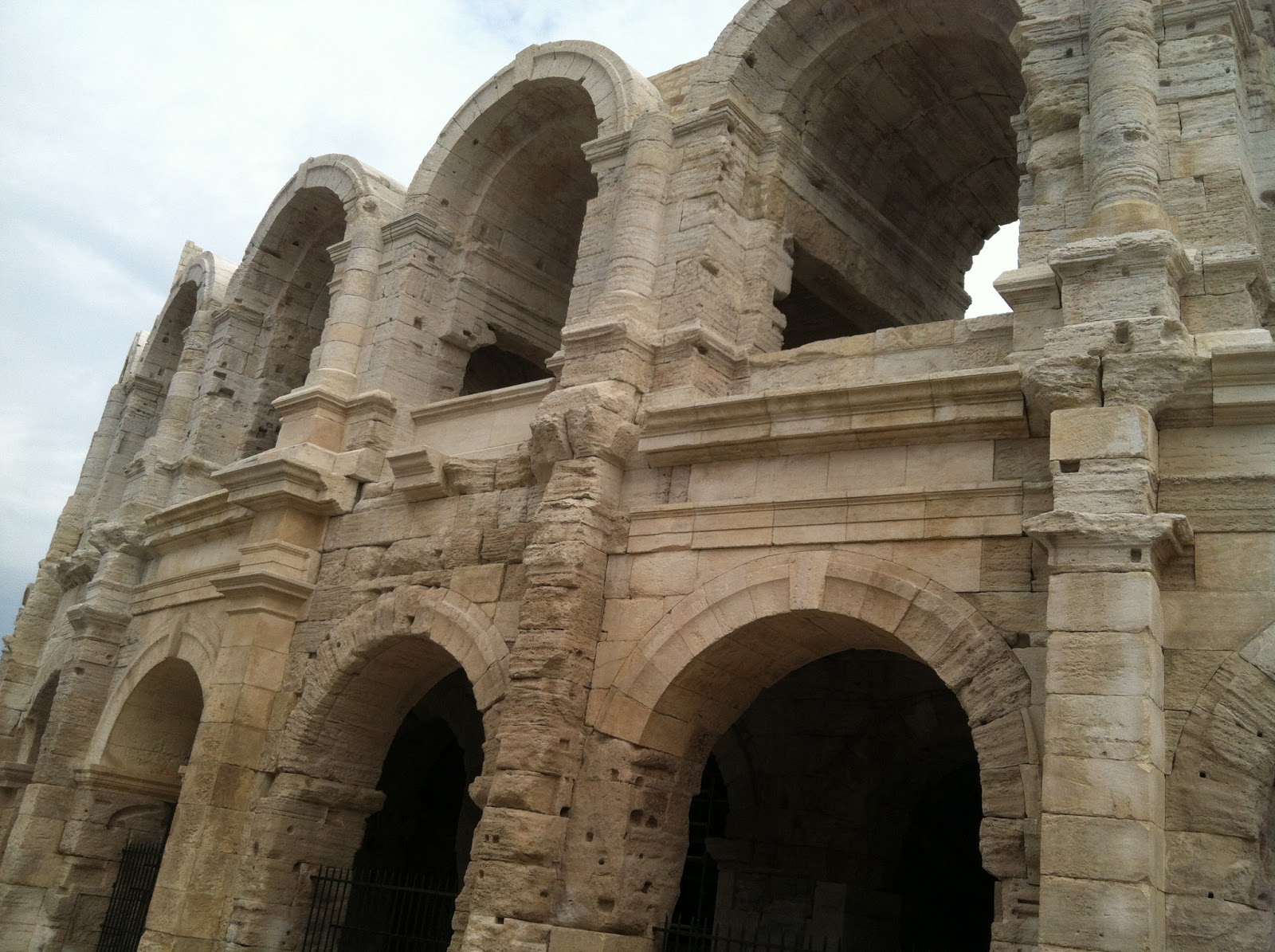
ARLES: Roman Colosseum

Colosseum Interior: still in use today

Central Entrance to Colosseum

Van Gogh - Le Cafe La Nuit

Facade of Holy Family Cathedral by Antoni Gaudi

Spires of Cathedral - still under construction

Keurig Coffee Single-Serve at Bullfight Arena Mall

Interior Supports for Bullfight Mall

Picasso's Mistress hanging in National Museum of Catalonia

MORE IMAGES: VIENNE TO AVIGNON

Vienne: View from the Castle

Vienne: Main Street

Vienne: Mural for Annual Theater Festival


The Bridge at Avignon
http://www.youtube.com/watch?v=uJKfxtYAt0s


Walls of Avignon
Interior Courtyard of the Papal Palace

Papal Palace of Avignon from the Babylonian Captivity when 2 popes ruled the Church - one in France and one in Rome


Marketplace in Uzes, source of spring for the Roman aqueduct, Pont du Gard

Placemats

Postcards

Uzes: Hotel de Ville (town hall)  17th C. on L, 15th C. on R - further to the right, 13th C facade

Olive Oil Manufacturing in Provence: Modern, Self-Cleaning Equipment

Olive Farm


Thursday, May 2, 2013

IMAGES FROM FRANCE: NORMANDY & THE RHONE


American Heroes of D-Day

The Cliffs at Pointe du Hoc

Cable Stay Bridge at Lyon - Contemporary amidst the Ancient

Crepe Maker in Old Lyon

Blooming in Beaujolais Country

Classic Citroen

Beaujolais Vineyard

Traditional Beaujolais Winery

Silk scarves from    www.atelierdesoierie.com 

Supplies for the Riverboat, Amadagio

Remains of Roman Road, Vienne

Temple to Roman Emperor, Augustus and his Wife, Livia

Vienne: WW I and WW II Memorial

Sunday, April 28, 2013

THE OLD PRESERVED IN BARCELONA

-->
       
The finest and most extensive collection of Romanesque frescoes from the 10th and 11th centuries may be seen at the National Museum of Catalonia (MNAC) in Barcelona.  Originally, these paintings were applied directly to the walls, ceilings and pillars of many of the small remote Romanesque churches in Spain and especially the Pyrenees. Recognizing that they art treasures were threatened in the modern age – by deterioration or pillage - the government of Catalonia made a plan to remove these frescoes intact.  Early in the 20th century, a small group of Italian restoration experts successfully carried out this incredibly delicate task. Having been transferred to a stretched cloth, these frescoes were transferred to an especially designed area of the museum where they are applied to wooden frames in the shape of the original wall, arch or pillar of the church from which they were taken.  The shapes of whole chapels and their component parts are duplicated with their original frescoes on the surface.  Sensing a chapel setting adds even more to the authenticity of the experience.  These aged frescoes, now seen in one location and protected by the museum, never will be destroyed by falling or leaking roofs, collapsing walls, and, as happened to several of them during the Spanish Civil War (1936-39), to be demolished in battle.  Here they are preserved as an amazing and accessible treasure from the distant past.

The museum utilizes the space of a building constructed for the International Exposition of 1929,  held in Barcelona. It sits on Montjuic, a hill overlooking the city, capital of the province of Catalonia. The name means Jews' hill.  Jewish culture thrived throughout the Iberian Peninsula in an era  known as the Golden Age.  Spain’s large, influential, and prolific Jewish community had a rich history until their tragic expulsion by Ferdinand and Isabella in 1492.

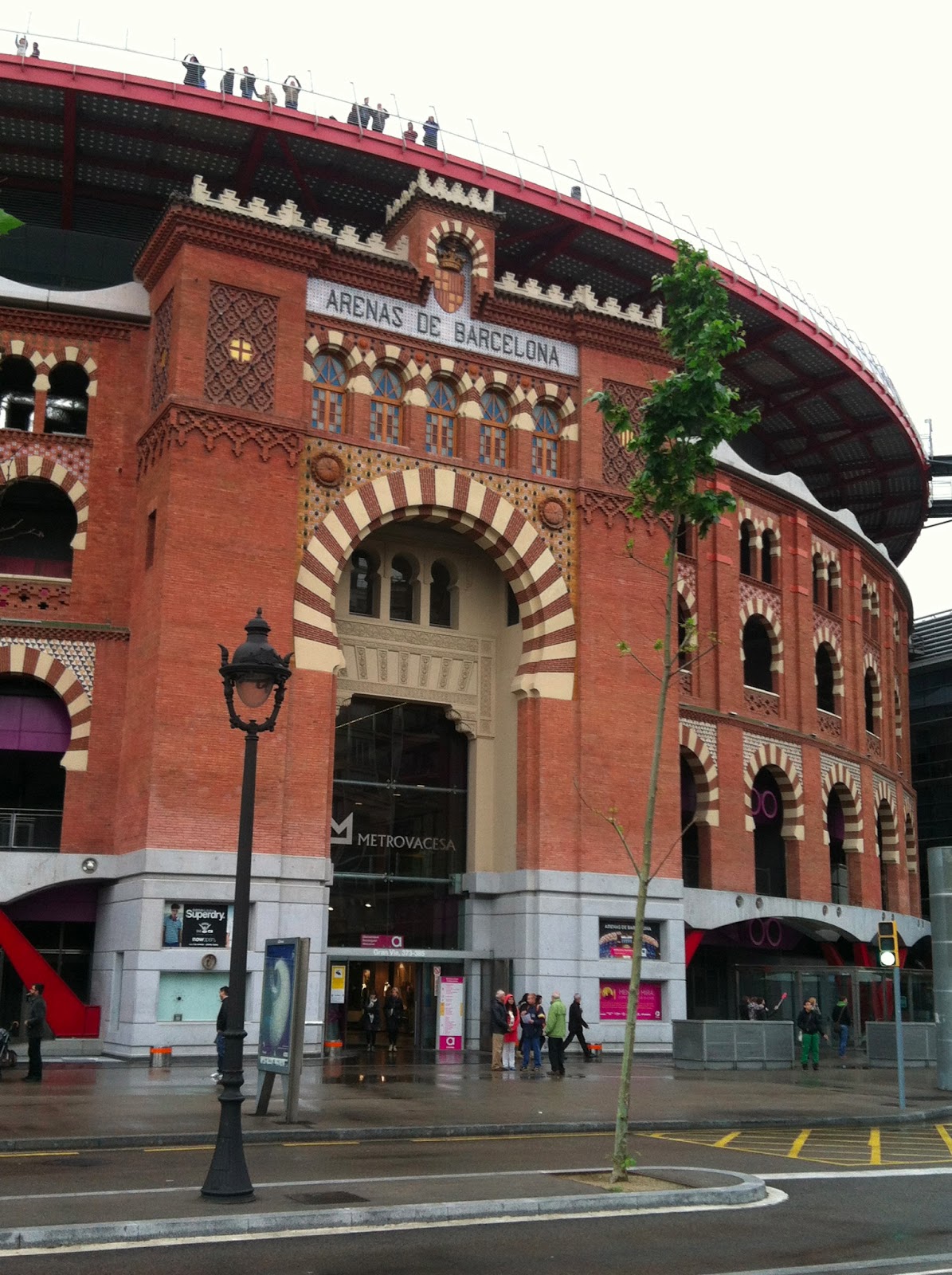
A different kind of preservation may be seen down the hill from the National Museum.  The entire brick exterior of the circular bullfighting arena located in downtown Barcelona has been transformed for a completely different purpose -- enclosing a modern shopping mall.  The stands and sand of the arena have been replaced with large bright yellow beams supporting three floors of glass fronted shops circling the inner side of the building. The formerly cheering crowds have been replaced by shoppers now entering to buy jewelry, clothes, cameras  --- goods from around the world.  The former focus of interest here, the bulls and matadors, are left to the imagination.
Frame for apse frescoes

Romanesque fresco with widowed donor at bottom right

Museum --  originally built for International Exposition, 1929

Museu Nacional d'Art de Catalunya

Former Bullfighting Arena

Interior of Shopping Mall


PONT DU GARD


Kayaking under the Pont du Gard

Arch with rectangular holes for beams to support scaffolding if repairs were needed

European Union portrayed Pont du Gard as unifying symbol on 5 Euro note
 
Were the Romans engineering geniuses? Seems so by visiting the Pont du Gard. 

To settle and maintain their civilization in Nimes, a free flow of fresh water was needed – for the Roman baths, drinking water, and sanitation. In just ten years, Romans directed the construction of a 50 km (31 mile) long aqueduct from the fresh, flowing springs in Uzes, a Roman military camp, to the Roman settlement in Nimes. Local slaves and prisoners provided the construction manpower.
What were the essentials in the design project?

Though the distance from spring to settlement was only 15 km, the aqueduct needed to wend through 31 km in order to maintain a gentle slope in the channel that carried the water.  This very precise downward slope took advantage of the fact that the drop in height from the spring to Nimes was only 11 meters, or approximately 10 inches per mile!

100 gallons per second traveled through the aqueduct from end to end. The water channel was covered to prevent evaporation of this precious resource.

Local limestone blocks were used to construct bridges – dry construction with no mortar. However, the Romans knew that limestone is porous and could not carry water. So, brilliantly they covered the channel with an impervious plaster made of broken tile, lard and other materials.

To cross streams and rivers, 20 arched bridges were built -- the greatest of which was the Pont du Gard with its three tiers of arches, standing 160 feet high.

Saturday, April 27, 2013

THE GALLO-ROMAN MUSEUM -- LYON (ANCIENT LUGDUNUM)

View of the Amphitheater through the sculptured concrete walls of the Museum. The governor built the amphitheater at his own expense.

Remains of a Roman Chariot with its freight

Frieze on sarcophagus

A segment of one of the finest bronze inscriptions from antiquity. Recording a speech in 48 CE by the Emperor Claudius in the front of the Roman Senate.

  Present day Lyon is at the confluence of the Soane and Rhone rivers. Founded in 43 BC as a colony of Rome, it was then known as Lugdunum and served as a center of Roman administration from the first century through the decline of the empire 400 years later. Shortly after the assassination of Julius Caesar, the new leaders of Rome decided that it would be best to move one of Caesar’s good friends and supporters out of Rome and away from the centers of power—a savvy political move.  Hence, Munatius Placus was given the assignment of founding and heading a colony in central Gaul -  far enough away to not be a threat, but at the same time useful to the Roman state. Lugdunum became a center for trade in wine, olive oil and other goods of the area – a veritable emporium.  High on a hill overlooking the modern city is the center of the Roman settlement with its amphitheater, Odeon, and remnants of baths and homes. 

Today the Gallo-Roman Museum, designed and constructed with wonderful concrete forms and carved into a hillside, overlooks these ancient sites.  Using the most modern museum design, it displays ancient Gallo-Roman artifacts – sculptures, friezes, jewelry, coins, and ceramics.  


.